

Growth & Development Milestones Every Parent Should Know

Watching a child grow is one of the most rewarding experiences for any parent. Understanding growth and development milestones helps parents track their child’s physical, emotional, cognitive, and social progress from infancy through childhood. These milestones are important indicators of healthy child development and help identify whether children are learning, communicating, moving, and interacting appropriately for their age. By recognizing developmental milestones early, parents can better support their child’s overall health and seek timely medical guidance when necessary.
Growth and development milestones refer to specific physical, emotional, social, cognitive, and communication skills that most children achieve within certain age ranges. These milestones act as important indicators of a child’s overall health and neurological development.
In today’s world, many parents are increasingly concerned about developmental delays, speech issues, screen-time effects, and behavioral changes in children. Questions such as “Is my baby developing normally?” or “When should my child start speaking clearly?” are very common. Understanding developmental milestones provides reassurance while also helping parents identify early signs that may require medical attention.
Monitoring child development is not about comparing one child to another. Instead, it is about understanding healthy developmental patterns and supporting children as they grow physically, emotionally, and intellectually.
This comprehensive guide explains the major growth and developmental milestones every parent should know, common warning signs of delays, and how parents can support healthy childhood development through proper care and regular pediatric checkups.
What Are Growth and Development Milestones?
Growth and development milestones are skills or behaviors that children typically achieve as they grow older. These milestones are grouped into different developmental categories because child development occurs across multiple areas simultaneously.
The main developmental areas include:
- Physical growth and movement
- Speech and language development
- Cognitive and learning abilities
- Social and emotional development
- Fine and gross motor skills
Growth refers to measurable physical changes such as height, weight, and head circumference. Development refers to how children learn, move, communicate, think, and interact with the world around them.
Every child develops differently, and slight variations are completely normal. However, understanding expected developmental milestones allows parents and healthcare professionals to identify concerns early and provide timely support when necessary.
Developmental milestones are especially important during the first five years of life because this period represents rapid brain development and learning.
Why Monitoring Child Growth and Development Milestones Is Important
Monitoring child development is essential because early childhood plays a major role in long-term physical, emotional, social, and intellectual health. During infancy and early childhood, the brain develops rapidly, forming connections that influence learning, communication, behavior, and emotional regulation.
Regular developmental monitoring helps identify whether a child is progressing appropriately for their age. In some cases, delays may indicate hearing problems, neurological disorders, nutritional deficiencies, speech disorders, or developmental conditions that require early intervention.
Parents who understand developmental milestones are often more confident in supporting their child’s growth. They are also more likely to notice subtle changes that may require medical attention.
Early recognition of developmental concerns is extremely important because intervention during the early years often produces better outcomes. Children who receive support early may experience improvements in speech, social interaction, learning ability, and physical coordination.
Developmental monitoring is not about creating pressure or unrealistic expectations. Instead, it helps ensure that children receive the care, support, and guidance they need during each stage of growth.
Infant Growth and Development Milestones (0–12 Months)
The first year of life is one of the most important stages of human development. Babies undergo rapid physical growth and neurological development during this period.
Infants gradually learn how to control their movements, recognize voices and faces, respond emotionally, and communicate through sounds and expressions. Pediatricians carefully monitor infant growth patterns because delays during this stage may indicate underlying health concerns.
Physical Growth Milestones During Infancy
Physical growth in infancy occurs very quickly. Most babies double their birth weight within the first few months and continue gaining height steadily during the first year.
During this stage, muscles strengthen progressively, allowing babies to gain better body control and movement coordination.
Common Physical Milestones During Infancy
- Holding the head up independently
- Rolling over from front to back
- Sitting without support
- Crawling
- Pulling up to stand
- Standing with support

These milestones reflect healthy muscle development, coordination, and neurological progress.
Parents should remember that some babies may skip crawling altogether and move directly to standing or walking. Variations like these can still fall within normal development.
Routine pediatric checkups help ensure that physical growth remains appropriate for the child’s age and developmental stage.
Cognitive and Sensory Development Milestones in Babies
Cognitive development refers to how babies learn, observe, and understand their surroundings. During infancy, babies become increasingly aware of sounds, faces, colors, movement, and emotional expressions.
Infants learn through interaction and sensory experiences. They begin recognizing familiar people, responding to voices, and exploring objects through touch and observation.
Important Cognitive Milestones
- Recognizing parents and caregivers
- Following moving objects with the eyes
- Responding to sounds and voices
- Showing curiosity toward surroundings
- Reacting to facial expressions
Talking, singing, reading, and interacting with babies regularly can significantly support cognitive development and strengthen emotional bonding.
Early Speech and Communication Development Milestones
Communication development begins long before children say their first words. Babies communicate through crying, facial expressions, sounds, and gestures from the earliest months of life.
As infants grow, they begin experimenting with sounds and responding to voices around them.
Common Communication Milestones
- Smiling socially
- Making cooing sounds
- Babbling repetitive syllables
- Responding to their name
- Expressing emotions through sounds
Parents can encourage speech development by speaking frequently with their baby, maintaining eye contact, and responding to sounds and gestures consistently.
Toddler Growth and Development Milestones (1–3 Years)
Toddlerhood is a stage of rapid movement, curiosity, language growth, and emotional development. During this period, children become increasingly independent and eager to explore their surroundings.
Toddlers develop stronger motor skills, improved communication abilities, and more advanced social interactions.
Gross Motor Skill Development in Toddlers
Gross motor skills involve large body movements that help children move, balance, and coordinate physical activity.
Toddlers gradually gain confidence in walking, climbing, and running.
Common Gross Motor Milestones
- Walking independently
- Running with improved balance
- Climbing stairs with assistance
- Kicking or throwing a ball
- Jumping in place
Physical activity is essential for strengthening muscles, improving coordination, and supporting healthy growth.
Parents should encourage safe active play while creating an environment that allows children to explore movement confidently.
Language Development During Toddlerhood
Language development accelerates significantly during the toddler years. Children begin understanding more words and expressing themselves verbally.
Toddlers often learn language by listening, imitating, and interacting with others around them.
Expected Language Milestones
- Saying simple words clearly
- Combining two-word phrases
- Following simple instructions
- Naming familiar objects and people
- Responding to questions
Reading books, storytelling, singing songs, and engaging in daily conversation can greatly improve language development.
Children exposed to regular verbal interaction often develop stronger communication skills and vocabulary.
Emotional and Social Development in Toddlers
Toddlers begin expressing emotions more strongly during this stage. They may display excitement, frustration, independence, affection, or anxiety more openly.
This period is important for emotional learning and social interaction.
Common Social and Emotional Milestones
- Showing affection toward family members
- Playing beside other children
- Expressing preferences and emotions
- Seeking independence
- Developing attachment to caregivers
Parents should encourage positive emotional expression while providing reassurance and structure.
Preschool Child Development Milestones (3–5 Years)
Preschool years are important for communication, learning, imagination, and emotional maturity. Children become more socially interactive and begin preparing for formal education.
During this stage, many developmental skills improve rapidly through play, learning activities, and social interaction.
Cognitive Development in Preschool Children
Cognitive development includes thinking, learning, memory, and problem-solving abilities.
Preschool children become increasingly curious and begin asking questions about the world around them.
Important Cognitive Milestones
- Identifying colors and shapes
- Counting numbers
- Understanding basic time concepts
- Following multi-step instructions
- Solving simple problems
Interactive learning activities and educational play help strengthen cognitive skills.
Language and Communication Skills in Preschoolers
Speech and language skills improve significantly during preschool years.
Children begin forming complete sentences and communicating thoughts more clearly.
Common Language Milestones
- Speaking in full sentences
- Telling simple stories
- Asking detailed questions
- Understanding conversations
- Using imaginative language during play
Parents should encourage open communication and provide opportunities for storytelling, reading, and conversation.
Fine Motor Skill Development
Fine motor skills involve smaller movements using the hands and fingers.
These skills are important for writing, drawing, dressing, and other daily activities.
Common Fine Motor Milestones
- Holding crayons correctly
- Drawing shapes and figures
- Using child-safe scissors
- Buttoning clothing
- Building block structures
Activities such as puzzles, coloring, crafts, and building toys can strengthen fine motor development.
School-Age Child Growth and Development Milestones (5–12 Years)
School-age children develop more advanced emotional, social, academic, and physical skills.
They begin building friendships, understanding responsibilities, and developing independent thinking.
Social and Emotional Growth
Children become more socially aware and emotionally mature during school years.
They learn teamwork, empathy, communication, and conflict resolution.
Key Social Milestones
- Forming close friendships
- Understanding rules and fairness
- Developing empathy for others
- Managing emotions better
- Building self-confidence
Positive family relationships and supportive school environments contribute greatly to emotional well-being.
Academic and Cognitive Development
Learning abilities become more complex as children progress through school-age years.
Important Academic Milestones
- Reading independently
- Solving mathematical problems
- Improving memory and concentration
- Understanding logic and reasoning
- Developing organizational skills
Healthy sleep, nutrition, emotional support, and reduced screen time help improve academic performance.
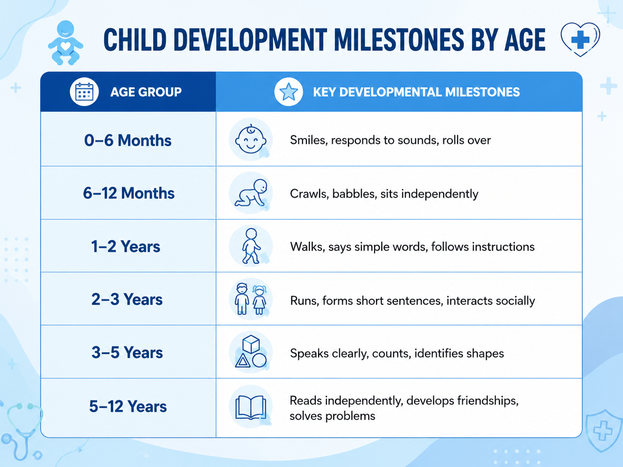
Child Growth and Development Milestones by Age (Table)
Signs of Developmental Delay Parents Should Watch For
Although every child develops differently, certain warning signs should not be ignored.
Possible signs of developmental delay include:
- No eye contact or social interaction
- Difficulty sitting, standing, or walking
- No babbling or speech delays
- Poor coordination or muscle weakness
- Difficulty understanding instructions
- Limited emotional interaction
Early evaluation by a healthcare professional can help identify developmental concerns and provide supportive therapies when needed.
How Parents Can Support Healthy Child Development
Parents play a major role in helping children grow physically, emotionally, and intellectually.
Encourage Active Play
Active play is essential for healthy physical development and motor coordination. Activities such as running, climbing, jumping, and outdoor games strengthen muscles and improve balance.
Children who participate in regular physical activity are more likely to develop confidence, coordination, and social interaction skills.
Parents should encourage age-appropriate physical activity daily while reducing excessive screen time.
Promote Healthy Nutrition
Nutrition plays a critical role in brain development, growth, immunity, and energy levels.
A balanced diet rich in fruits, vegetables, proteins, healthy fats, vitamins, and minerals supports healthy development.
Poor nutrition during childhood may affect concentration, learning ability, and physical growth.
Parents should encourage healthy eating habits early to support long-term wellness.
Read and Communicate Daily
Reading and communication help improve vocabulary, imagination, emotional bonding, and cognitive development.
Children exposed to regular storytelling and conversation often develop stronger language and comprehension skills.
Simple daily interactions such as asking questions, singing songs, and discussing activities can positively influence speech development.
Ensure Adequate Sleep
Sleep is extremely important for memory, emotional regulation, immune function, and physical growth.
Children who do not get enough sleep may experience difficulty concentrating, behavioral issues, and reduced learning performance.
Creating consistent bedtime routines helps improve sleep quality.
Attend Regular Pediatric Checkups
Routine pediatric visits help monitor developmental milestones, vaccinations, growth patterns, and nutritional health.
Preventive healthcare allows doctors to identify developmental concerns early and guide parents appropriately.
Regular health monitoring is essential even when children appear healthy.
Pediatric Care and Development Support in Ras Al Khaimah
Parents looking for trusted pediatric and child healthcare services can benefit from regular developmental evaluations and preventive pediatric care.
At Platinum Medical Center, pediatric healthcare focuses on child wellness, developmental monitoring, vaccinations, nutritional guidance, and preventive care to support healthy childhood development.
Conclusion
Understanding growth and development milestones helps parents support their child’s health with confidence and awareness. From infancy to school age, every stage of development contributes to a child’s physical, emotional, intellectual, and social growth.
Although children develop at different rates, recognizing developmental milestones and attending regular pediatric checkups are essential for identifying potential concerns early. Visiting a trusted pediatric clinic in Ras Al Khaimah for routine developmental monitoring can help ensure healthy growth and timely medical guidance.
With supportive parenting, healthy habits, and timely medical care from a qualified pediatric doctor, children can achieve healthier developmental outcomes and improved long-term well-being.
Child development milestones are age-specific skills that children achieve as they grow physically, emotionally, socially, and cognitively.
Parents should consult a healthcare professional if a child experiences significant delays in speech, walking, social interaction, or coordination.
Pediatric checkups help monitor growth, vaccinations, nutrition, and developmental progress while identifying potential concerns early.
Excessive screen time may affect communication, sleep quality, social interaction, and physical activity levels in children.
Parents can support healthy development through balanced nutrition, active play, communication, quality sleep, emotional support, and regular pediatric care.
Recent Blogs
- IV Vitamin Therapy: What You Should Know Before Your First Session
- Post-Pregnancy Care for New Mothers: A Complete Guide to Recovery After Childbirth
- Childhood Vaccination Schedule in UAE: A Parent’s Complete Guide
- Iron Deficiency in Women: Signs You Shouldn’t Ignore
- Growth & Development Milestones Every Parent Should Know
- Common Gynecological Problems Women Should Not Ignore
- Early Signs Your Body Is Asking for a Health Checkup
- Essential Tests During Pregnancy: A Complete Guide for Expecting Mothers
- Common Health Problems in the UAE & How to Prevent Them
- Women’s Health: Understanding Hormonal Changes

